
Review · BEITEDDINE & DEIR EL QAMAR TOURS
Guided Small-Group Tour to Beirut, Beiteddin & Deir elQamar
Two sides of Lebanon in one day. This tour pairs Beirut’s seaside landmarks, religious buildings, war history, and Roman remains with the mountain villages of Deir el Qamar and Beiteddine Palace. I like the smart route, especially the contrast between the Pigeon Rocks and Beirut Corniche and the quieter stone streets of Deir el Qamar. I also like that lunch, hotel pickup, transport, and a guide are included in the $99 price. The main drawback is the pace: with roughly 10 to 15 minutes at many Beirut stops, you will see a lot but rarely linger.
For me, the strongest reason to book is the variety. In one day, you move from a Mediterranean waterfront to Ottoman-era mosques, a Greek Orthodox cathedral, civil-war landmarks, Roman baths, and a 19th-century palace. The Beiteddine Palace admission fee is not included, so check that extra cost before booking, and keep in mind that the eight-hour schedule leaves little room for independent wandering.
In This Review
- Six details that shape the day
- Why this Beirut and Chouf combination works
- Raouché and the Corniche: Beirut opens with sea air
- Zaitunay Bay and the Holiday Inn: New money, old wounds
- Downtown Beirut’s mosques, churches, and public squares
- Deir el Qamar: a mountain village with many faiths
- Beiteddine Palace: the main reason to take the mountain route
- Lunch, group size, and the real value of $99
- Who should book this day out
- Should you book the Beirut and Beiteddine tour?
- FAQ
- How long does the tour last?
- What time does the tour start?
- Is hotel pickup and drop-off included?
- Is lunch included?
- Is transportation provided?
- How many people can join the tour?
- Is admission to Beiteddine Palace included?
- Can I cancel for a full refund?
Six details that shape the day
- Pigeon Rocks begins the morning with Beirut’s big coastal view: The Raouché rock formations are a quick but memorable introduction to the city.
- Beirut’s religious center is unusually compact: The Mohammad Al-Amin Mosque, Al-Omari Mosque, and Saint George Cathedral are all part of the downtown route.
- The Holiday Inn adds difficult modern history: Its abandoned shell recalls the Battle of the Hotels during Lebanon’s Civil War.
- Deir el Qamar brings a slower mountain-town feel: You see a mosque, church, old civic center, and a town shaped by several religious communities.
- Beiteddine Palace is the day’s main interior visit: Allow 90 minutes to appreciate its courtyards, architecture, and museum areas.
- The small group is capped at 15 people: That is a more manageable size than a large coach tour, though the exact group size may vary.
Why this Beirut and Chouf combination works
Many city tours stop when the capital’s modern center starts to make sense. This one continues into the Chouf District, giving you a better picture of Lebanon’s cultural range. You get Beirut’s dense urban story first, then the mountain setting and palace architecture that shaped Mount Lebanon’s political past.
The timing is ambitious. The tour starts at 8:30 a.m. and lasts about eight hours, including the drive between Beirut and the Chouf. Most city stops are listed at 10 minutes, with 30 minutes at Deir al-Qamar Municipality, 15 minutes at Fakhreddine’s Mosque, 15 minutes at Saydet El Talle Church, and 90 minutes at Beiteddine Palace.
That means this is best treated as a guided introduction rather than a slow museum day. I would choose it if I wanted a broad first look and did not want to arrange several separate rides. If you prefer long café breaks, detailed photography, or extended time inside each religious site, the schedule may feel tight.
Transportation is by air-conditioned vehicle, with hotel pickup and drop-off offered. That matters here. Beirut and the Chouf sites are not one compact walking route, and having transport arranged removes much of the day’s practical fuss.
More Beiteddine and Deir el Qamar tours:
- Guided small group to Cedars Reserve & Beiteddine w/lunch+entries
★ 5.0 · 12 reviews - Beirut, Beiteddine & DeirElQamar Day Trip-With Lunch(4G on Board)
★ 4.5 · 12 reviews - Cedars Shouf & Beiteddine w/pick-up, guide, entries+lunch
★ 4.7 · 12 reviews
Raouché and the Corniche: Beirut opens with sea air
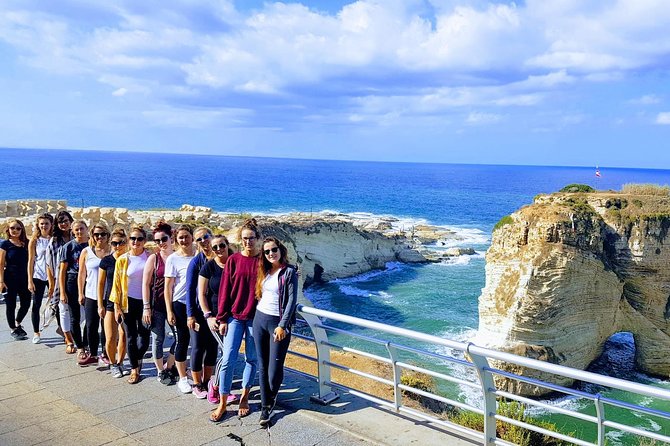
The first stop is Pigeon Rocks at Raouché, on Beirut’s western tip. Two large rock formations rise from the Mediterranean, and the brief visit gives you the city’s classic coastal image almost immediately.
Ten minutes is enough for a look, photographs, and a quick orientation. It is not enough for a long walk along the shore, so set your expectations accordingly. The wider Al Manara Corniche stretches from Ramlet al Bayda toward the Saint George marina, with palms, sea views, Pigeon Rock, and Mount Lebanon visible inland.
I like this opening because it gives the day a clear sense of place. Beirut is not only old streets and monuments. It is also a seaside city, and the Corniche helps you understand that before the route turns toward downtown.
Zaitunay Bay and the Holiday Inn: New money, old wounds
Zaitunay Bay is a newer waterfront area with shops and restaurants. The stop is short, but it shows another side of Beirut: leisure, redevelopment, and the city’s modern relationship with the sea.
The sharper contrast comes next, with the abandoned Holiday Inn. Built between 1971 and 1974, the hotel operated during Beirut’s economic boom before the Civil War began in 1975. It later became part of the Battle of the Hotels, a conflict in which rival forces fought for control of major hotel buildings.
The empty structure remains a war landmark. You do not visit it for polished architecture or a conventional attraction. You see it as a reminder that Beirut’s recent past is still physically present in the city.
This is one of the most valuable parts of the route because it keeps the tour from presenting Beirut as only picturesque. The city’s scars are part of its story. The stop is observational rather than an extended site visit, so your guide’s explanation will matter greatly.
Downtown Beirut’s mosques, churches, and public squares
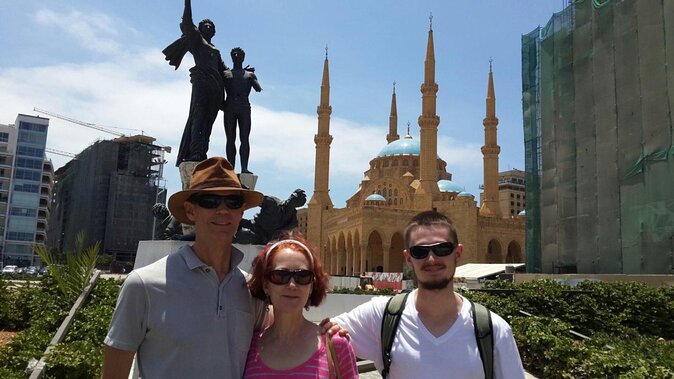
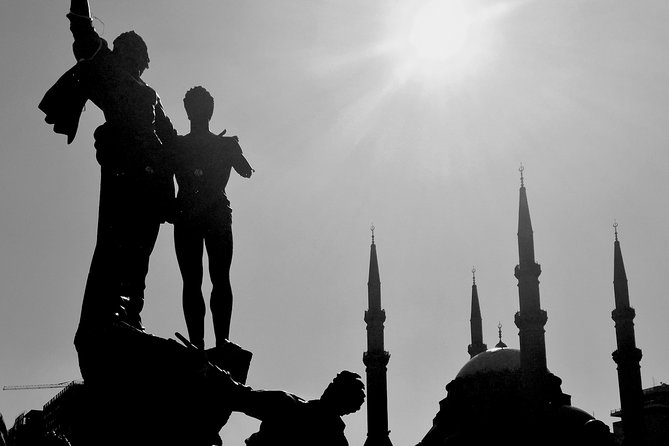
The downtown section packs several important places into a compact circuit. At the Mohammad Al-Amin Mosque, also called the Blue Mosque, you see Lebanon’s largest mosque. Opened in 2008, it is known for its blue-tiled domes, tall arches, and four minarets rising about 65 meters.
The visit is scheduled for 10 minutes. That is enough to see the exterior and understand its position near Martyrs’ Square, but not enough to explore every architectural feature at leisure.
Al-Omari Grand Mosque gives you a much older layer. Its origins are associated with the seventh century, and the building later served as a church before becoming a mosque again under the Mamluks in 1291. It was damaged during the Civil War and refurbished in 2004.
Nearby, the Greek Orthodox Cathedral of Saint George occupies a site linked to an early Christian temple and to Beirut’s historic law school. The current church is associated with the Greek Orthodox community and is considered the city’s oldest church.
I value these three stops together because they show how Beirut’s religious history is not separated into distant quarters. Mosques and churches share the downtown story, and the guide can help connect the buildings to the city’s changing rulers, communities, and conflicts.
Martyrs’ Square adds a political layer. The square recalls the executions of Lebanese nationalists by Ottoman authorities on May 6, 1916. Its older names, Al Burj and Place des Cannons, point to the many chapters behind one central public space.
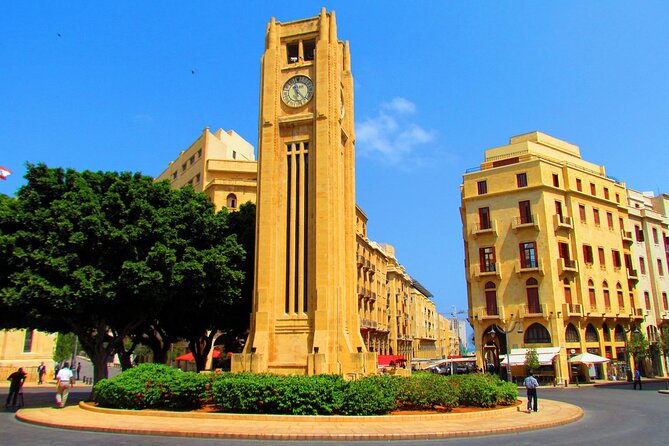
Place de l’Étoile is more orderly in appearance, with its recognizable four-faced Rolex clock from the 1930s. The square is home to the Lebanese Parliament and nearby religious, cultural, and commercial buildings. You get about 10 minutes here, so look up at the architecture and note the clock before moving on.
Beirut Souks then shifts the mood again. The district includes more than 200 shops, 25 restaurants and cafés, an entertainment center, and a cinema complex. It is a commercial zone rather than an old market in the traditional sense, but it shows how the city center has been rebuilt and used today.
The Roman Baths are the final downtown stop. The remains were found in 1968 and 1969, restored in the 1990s, and linked to four major bath complexes. The first was created in the early first century under Augustus, while an earthquake in 551 damaged the baths badly.
The site is outdoors and relatively easy to view quickly. One bath area is also used for artistic performances and concerts, an appealing example of ancient remains serving present-day city life.
More tours and day trips worth a look
- Guided Small-Group Tour to Baalbek, Anjar and Ksara with Lunch
★ 5.0 · 511 reviews - Guided Small-Group Tour to Jeita, Harissa, Byblos with Lunch
★ 5.0 · 361 reviews - Guided Private Full Day Tour to Baalbek, Anjar and Chateau Ksara
★ 5.0 · 60 reviews - Private Guided Tour to Jeita Grotto through Harissa and Byblos
★ 5.0 · 48 reviews
Deir el Qamar: a mountain village with many faiths
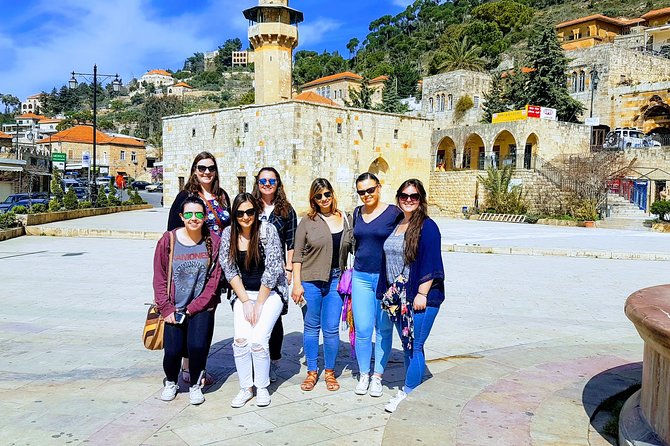
After Beirut, the tour heads toward Deir el Qamar, about five kilometers from Beiteddine Palace. The name means Monastery of the Moon, and the village offers a very different rhythm from the capital.
You have about 30 minutes at the municipality area, which is the longest stop before the palace. Deir el Qamar became Lebanon’s first village with a municipality in 1864. It is also known for producing artists, writers, and politicians.
The village’s religious mix is central to its identity. Its past includes Christian churches, a mosque, and a synagogue, reflecting a period when people from different religious communities lived in the same town. Deir el Qamar was destroyed by fire during the conflict between Druze and Christians in 1860, then rebuilt with help from a French contingent sent by Napoleon III.
This context makes the village more than a photogenic stop. Look at it as a place shaped by cooperation, conflict, and rebuilding. The short visit gives you a taste of the setting, though anyone wanting a detailed walk through every lane will want more time than the standard schedule provides.
Fakhreddine’s Mosque is a particularly useful stop because it connects the village to Mount Lebanon’s ruling families. Built in 1493 and restored in the 16th century by Fakhreddine I, it is considered the oldest mosque in Mount Lebanon. Its octagonal minaret is the feature to watch for.
Saydet El Talle Church, or Our Lady of the Hill, dates to the 15th century and is one of Deir el Qamar’s key religious sites. The church is tied to an older Phoenician site associated with Astarte and to local traditions about a light seen on the hill.
The mosque and church sit within the same compact village visit, making the point better than a lecture alone. You see how layers of belief and local legend occupy the same ground. The scheduled 15 minutes at each site will give you a guided look, but not a long private visit.
Beiteddine Palace: the main reason to take the mountain route
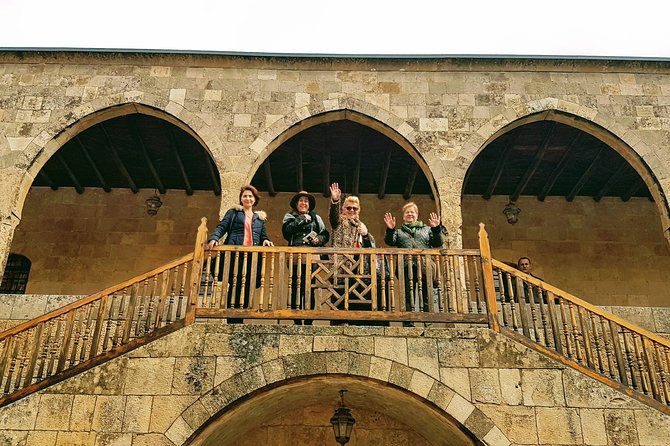
Beiteddine Palace is the day’s centerpiece, with 90 minutes set aside for the visit. Built by Emir Bashir Chehab II between 1788 and 1818, it is regarded as Lebanon’s best example of early 19th-century Lebanese architecture.
The name means House of Faith. The palace later served the Ottoman government, then became a local administrative office during the French Mandate. In 1943 it was declared the president’s official summer residence. During the Civil War it suffered heavy damage, and parts remain reserved for the president’s summer use.
The palace also houses the Beiteddine Palace Museum and hosts the annual Beiteddine Festival. The longer stop gives you time to see more than an exterior facade. You can study the courtyards, decorative details, and the way the complex combines residence, administration, and ceremony.
I would save energy for this visit. The Beirut portion is fast, and the palace is where the itinerary finally allows you to slow down. Since admission is not included in the $99 price, budget for that separately. The tour price still has solid value because it includes hotel pickup and drop-off, an air-conditioned vehicle, a guide, a small group, and lunch.
Lunch, group size, and the real value of $99
Lunch is included and described as a fresh, authentic Lebanese meal. No menu is specified, so do not book this expecting a particular dish. The inclusion is useful because the day is tightly timed, and you will not need to arrange a separate midday meal.
At $99 per person, this is not the cheapest possible way to see Beirut. It is a fair price for a full-day route that combines city transport, mountain transport, a guide, lunch, and hotel transfers. The value improves if you are staying in Beirut and want to see Beiteddine without arranging a private car.
The small-group limit is 15 people. That should make it easier to hear explanations and ask questions than on a large bus. It is still large enough that the group may not move at your preferred pace, especially at the shorter downtown stops.
The experience has a five-star rating based on seven published ratings, and the strongest praise centers on the chance to see Beirut and Beiteddine in one day. That is exactly the tour’s appeal: it gives you two very different settings without requiring you to plan the connections yourself.
Who should book this day out
I would recommend this tour to a first-time visitor with one free day in Beirut, especially if you want both urban landmarks and Mount Lebanon history. It also suits anyone who prefers a guide to explain the religious and political background instead of simply taking photographs and moving on.
It is a good match for people who value convenience. Pickup, drop-off, lunch, and air-conditioned transport remove several decisions from a complicated day.
I would hesitate if you have already spent several days in Beirut and want a slow, specialist visit to the city center. The 10-minute stops are useful for orientation but can feel hurried. I would also think twice if Beiteddine Palace is your only priority, since a private visit could give you more flexibility.
Most people can participate, and the maximum group size is 15. Confirmation is provided when you book. Free cancellation is available until 24 hours before the start time, but cancellations or changes inside that window are not accepted for a refund.
Should you book the Beirut and Beiteddine tour?
Book it if you want a wide-angle introduction to Lebanon in one organized day. The route gives you sea views, religious landmarks, war history, Roman archaeology, a multi-faith mountain village, and one of the country’s finest palaces.
Skip it if your ideal day means long lunches, unhurried museum visits, or exploring Beirut’s streets independently. For everyone else, the combination is unusually efficient. Keep your expectations realistic, bring the energy for a full schedule, and treat the short stops as an introduction rather than the final word on each site.
FAQ
How long does the tour last?
The experience lasts approximately eight hours.
What time does the tour start?
The stated start time is 8:30 a.m.
Is hotel pickup and drop-off included?
Yes. Hotel pickup and drop-off are included.
Is lunch included?
Yes. Lunch is included and is described as a fresh, authentic Lebanese meal.
Is transportation provided?
Yes. The tour uses an air-conditioned vehicle, and comfortable transportation is included.
How many people can join the tour?
The maximum group size is 15 people.
Is admission to Beiteddine Palace included?
No. Admission to Beiteddine Palace is not included in the tour price.
Can I cancel for a full refund?
Yes, if you cancel at least 24 hours before the experience start time. Cancellations or changes made less than 24 hours before the start time are not accepted for a refund.
Just added around Beirut
- Private Full-Day Tour to Jeita Grotto, Harissa and Saint Charbel from Beirut★ 5.0 · 3 reviews
- Beirut to Jeita Grotto and Byblos: Daily Tours with Lunch★ 5.0 · 3 reviews
- PRIVATE city tour of Old Sidon & Historic Tyre★ 5.0 · 3 reviews
- Journey Through Time: Half-Day Private Tour to Baalbek★ 5.0 · 3 reviews
- Small-Group Tour to Sidon, Tyre and Maghdouche with Lunch and Tickets★ 4.5 · 3 reviews
- Beirut to Sidon, Tyre and Maghdouché: Daily Tours with Lunch★ 5.0 · 3 reviews
- Hike Chouwen★ 5.0 · 3 reviews
- Private Full-Day Tour to Byblos and Tripoli from Beirut★ 5.0 · 3 reviews
Beiteddine & Deir el Qamar Tours, compared.
Cedars Shouf & Beiteddine w/pick-up, guide, entries+lunch
Read our review →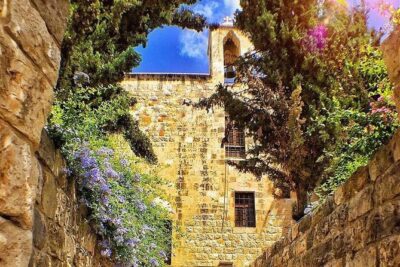
Beirut, Beiteddine & DeirElQamar Day Trip-With Lunch(4G on Board)
Read our review →
Guided small group to Cedars Reserve & Beiteddine w/lunch+entries
Read our review →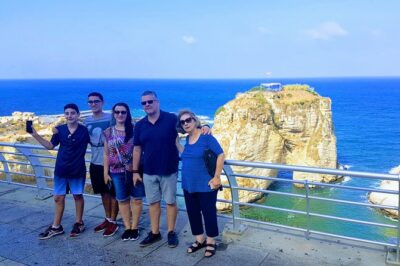
Small Group Tours to Beirut, Beiteddine & Deir el Qamar with lunch and all fees
Read our review →
Deir el Qamar – Beiteddine Palace – Chouf Cedars From Beirut
Read our review →
Deir Al-Qamar, Beiteddine Palace and Barouk Cedars Tour
Read our review →
PRIVATE Hiking Day Trip in the Shouf Fabulous Cedars Forest
Read our review →
DeirElkamar, Beitdeen, Moussa Palace, EinwZien Grotto,Full-Day Trip PRIVATE-CAR
Read our review →Browse the lists this tour appears in